The Real Cost of a Bad Return Policy
Half of shoppers say a return policy has affected whether they bought at all. And the ecommerce return rate is climbing, not falling.
Most merchants think about return policy as a cost centre, something to minimise, restrict, and hope customers don't use too often. The data tells a more complicated story: your return policy isn't just a cost. It's actively shaping whether people buy from you in the first place.
Returns are rising, not falling
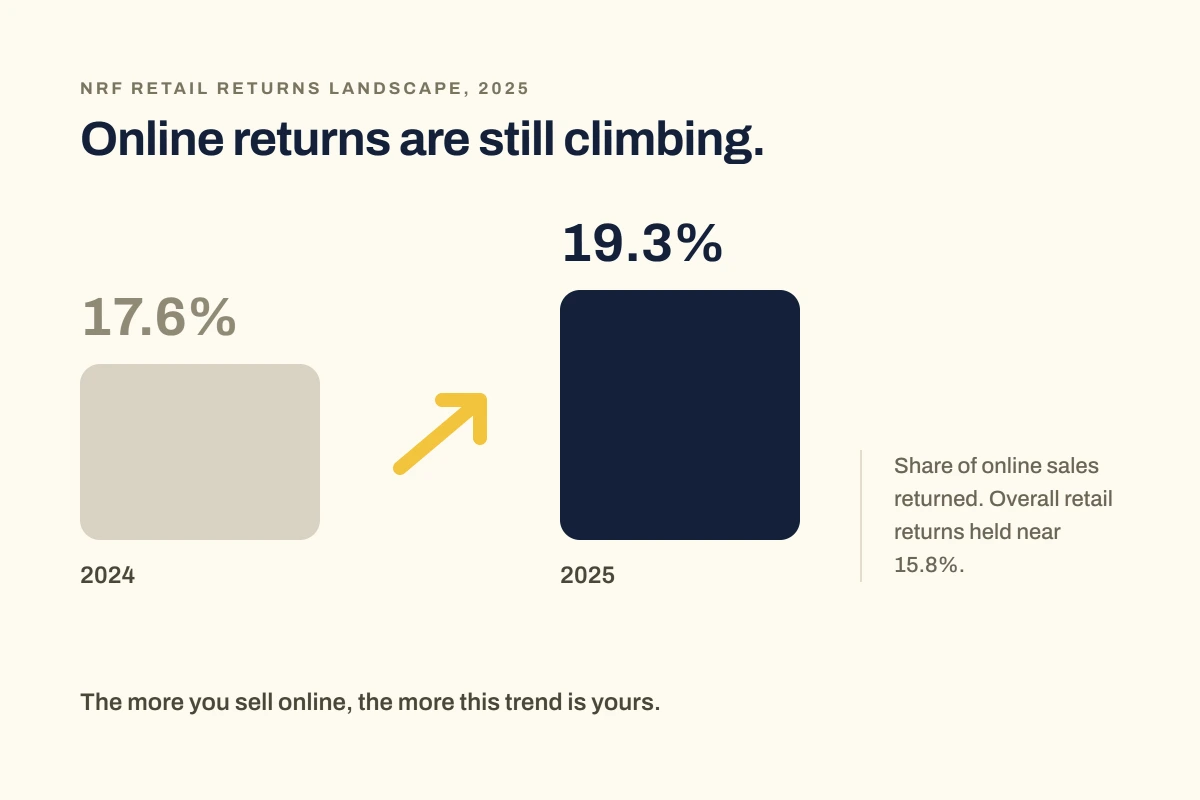
Start with the trend line. According to the National Retail Federation and Happy Returns, a UPS company, in their 2025 Retail Returns Landscape report, the overall retail return rate in 2025 was 15.8% of annual sales, around $849.9 billion in merchandise, actually a slight dip from 16.9% in 2024.
The ecommerce-specific number tells a different, more relevant story for a Shopify store: 19.3% of online sales were returned in 2025, up from 17.6% the year before. Online returns are climbing while overall retail returns hold roughly steady, which means the more your business skews online, the more this trend applies directly to you.
The report, based on surveys of over 2,000 consumers and 358 ecommerce professionals, also found that 9% of all returns are classified as fraudulent, and Gen Z shoppers return the most of any generation, averaging 7.7 online returns a year.
Return policy affects the sale, not just what happens after it
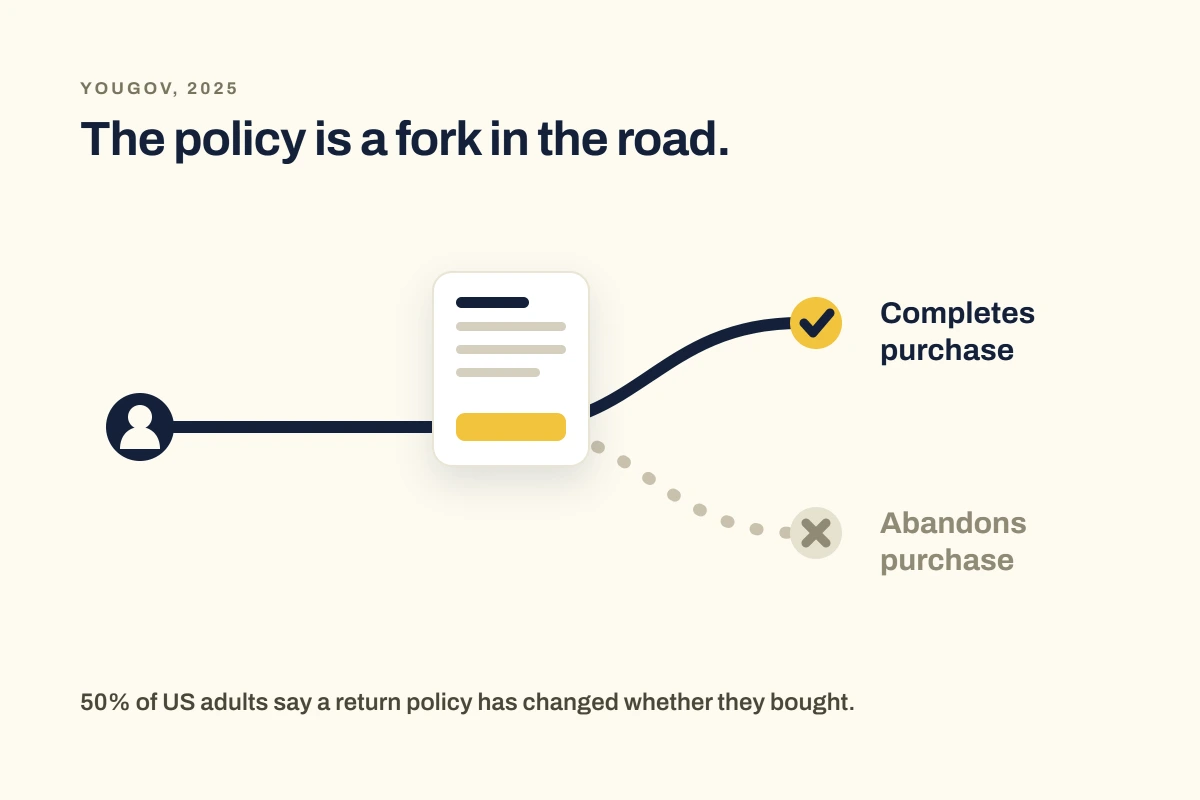
Here's the part that's easy to miss if you only think about returns as a post-purchase problem. YouGov, an independent, established pollster, found that half of US adults say a retailer's return policy has directly affected whether they completed a purchase, 55% among women, 45% among men. Among shoppers who weigh return policies at all, free returns is the single most influential factor: 75% say it affects their decision to buy, rising to 80% among women.
This isn't a fringe consideration. It's a mainstream part of the buying decision, sitting quietly upstream of the sale itself, not just downstream of it.
A separate, genuinely independent academic synthesis backs this up with real intellectual weight. Researchers at the University of Texas at Dallas reviewed 21 academic papers spanning economics, marketing, consumer psychology, and operations research, and found a consistent pattern: lenient return policies reliably increase purchases. There's also a real, smaller increase in returns that comes with it, but the relationship isn't uniform, it depends which specific lever you loosen: time, cost, effort, scope, or exchange flexibility.
What shoppers actually want
If you're wondering where to focus, the data is fairly consistent across independent sources. YouGov found the top reasons people return items are that the product didn't meet expectations on quality, colour, or size (44%), poor fit (39%), and damaged or defective items (34%). Notice that the first two reasons aren't really about the return policy at all, they're about a mismatch between expectation and reality, which return policy can only partially fix.
A returns-management platform called Route, which sells software in this space and so should be read with that context in mind, surveyed 1,000 US shoppers and found figures consistent with the independent research: 93% review a return policy at least occasionally before buying, 82% say easy returns influence whether they try a new brand, and 97% say a good return experience makes them more likely to buy again. On the flip side, 43% said they'd avoid a brand entirely after being denied a return.
What this means practically
A few things worth acting on:
- Make your policy visible before checkout, not buried in a footer link. Nearly all shoppers check it, so hiding it just adds friction at the worst possible moment.
- Offer free returns where your margins allow it. It's the single most influential factor across every source cited here.
- Attack the root cause, not just the policy. Since "didn't meet expectations" and "poor fit" are the top two return reasons, and neither is really about your return policy at all, the biggest lever isn't always a more generous policy. It's helping someone choose the right thing the first time. Clear sizing guides, honest photography, and detailed product information all reduce returns before they happen.
- A mismatched purchase is the expensive kind of return. A well-fitting product returned because a customer changed their mind is a normal cost of doing business. A product returned because it was never right for that customer in the first place is a cost you could have avoided upstream. This is directly relevant to what we build at Suggesto, since a short guided quiz that points someone to the right product before they buy is one honest way to reduce that second, avoidable category. It's not the only way, better sizing charts and clearer photos do real work here too, but it's worth naming as one of the levers available.
Key takeaways
Return policy isn't just an operational afterthought. It's a genuine, independently documented factor in whether someone buys from you at all, and the ecommerce return rate is trending upward, not down. The cheapest fix isn't always a more lenient policy. It's reducing the number of purchases that were mismatched from the start.
Frequently Asked Questions
Does return policy really affect whether people buy?
Yes. According to YouGov's independent research, half of US adults say a retailer's return policy has affected whether they completed a purchase, and free returns specifically influences the buying decision for roughly three-quarters of shoppers who consider return policies.
What's the average ecommerce return rate?
According to the National Retail Federation's 2025 Retail Returns Landscape report, the ecommerce-specific return rate was 19.3% in 2025, up from 17.6% in 2024. This is higher than the overall retail return rate of 15.8%, since online returns consistently run above in-store returns.
Do lenient return policies increase returns as well as purchases?
According to an academic review of 21 studies by University of Texas at Dallas researchers, lenient return policies reliably increase purchases, along with a smaller but real increase in returns. The effect depends on which specific policy element is loosened, such as time allowed, cost, or scope.
What's the biggest reason customers return products?
According to YouGov, the top reasons are the item not meeting expectations on quality, colour, or size (44%), poor fit (39%), and damaged or defective items (34%). Both of the top two reasons point to a mismatch between what the customer expected and what they received.
References
- National Retail Federation & Happy Returns. 2025 Retail Returns Landscape (October 2025).
- YouGov. Free, Fast and Convenient: How US Shoppers Want Retail Returns (November 2025).
- University of Texas at Dallas, Naveen Jindal School of Management. Academic review of return policy research.