Customer Lifetime Value 101: The Metric Most Small Shopify Stores Ignore
You've heard that a 5% retention boost raises profit 25 to 95%. The real 1990 study behind that claim says something more specific and more useful.
You've probably seen this statistic before: increase customer retention by just 5%, and profit rises by 25% to 95%. It shows up in nearly every article about why retention matters, usually attributed to Bain & Company. It's a genuinely useful idea. It's also, in its most commonly repeated form, not quite what the original research said.
The stat everyone quotes, and what it actually says
The real source is a 1990 Harvard Business Review paper by Frederick Reichheld and W. Earl Sasser, called "Zero Defections: Quality Comes to Services." Someone who actually tracked down the original research found something worth knowing: the "95%" upper bound that gets repeated everywhere isn't clearly supported in the short Bain brief it's usually credited to.
What the original study actually found was more specific, and arguably more useful, than the flattened version everyone quotes. Reichheld and Sasser looked at real companies across different service industries and found that cutting the customer defection rate by 5% raised profit by different amounts depending on the industry: 85% in one bank branch system, 50% in an insurance brokerage, and 30% in an auto-service chain. Different businesses, different numbers, not one universal law. And notably, the study covered banking, insurance, and auto services in 1990, not ecommerce.
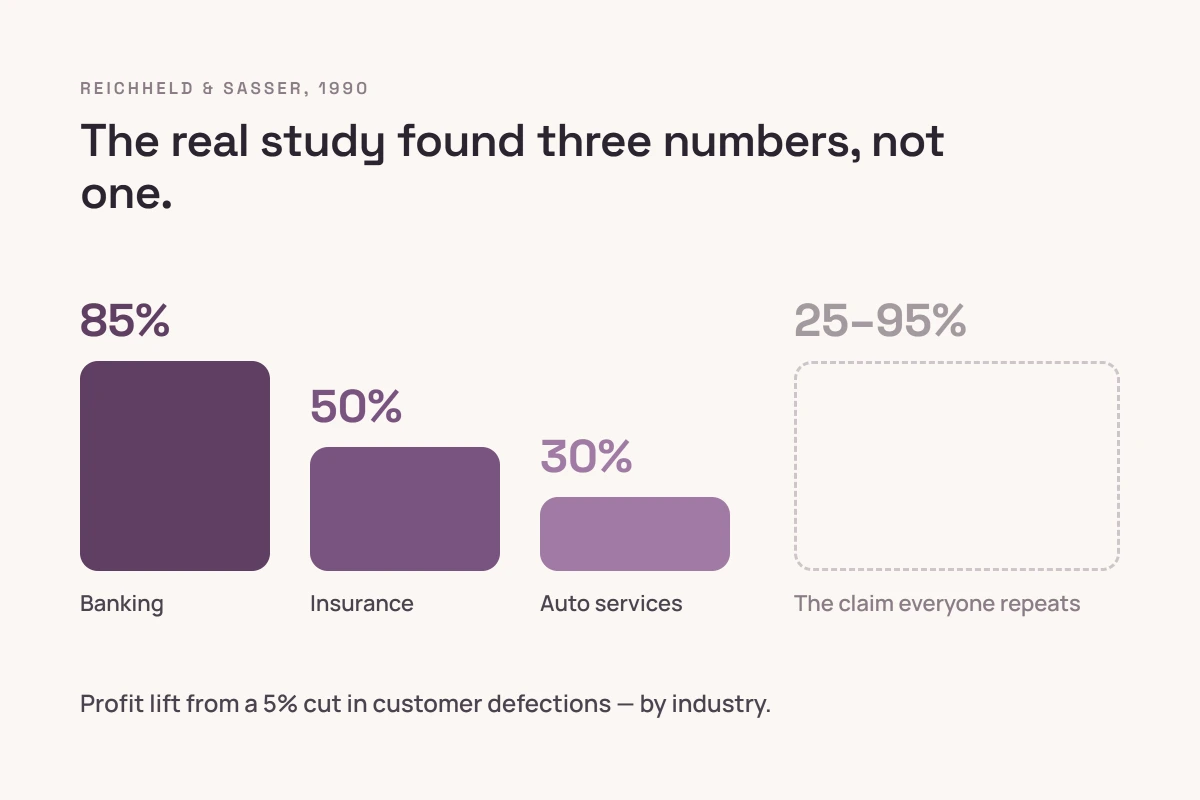
None of this means retention doesn't matter. It means the tidy "25 to 95%" soundbite has drifted from something specific and industry-dependent into something that sounds like a precise, universal formula. It isn't one. Use the real range as a heuristic, not a promise.
Why this matters more than acquisition cost alone
Customer lifetime value, or CLV, is the total revenue a business can expect from a single customer over the entire relationship, not just the first order. It's the number that makes retention math make sense: a customer who spends £40 once is worth far less than a customer who spends £40 five times, even though the first purchase looks identical on both.
Most small stores track customer acquisition cost closely, what it costs in ads and marketing to win someone, but far fewer track what that customer is actually worth over time. That's a real blind spot. A £35 acquisition cost looks expensive against a single £40 order. It looks completely different against a customer who returns four times over a year.
Harvard Business Review's own 2014 follow-up on this topic cites another widely used figure: acquiring a new customer typically costs 5 to 25 times more than retaining an existing one. HBR is upfront that this is a range, not a precise number, and depends heavily on "which study you believe and what industry you're in." Treat it the same way, as a directional signal, not a formula to plug into a spreadsheet.
How to actually start tracking it
You don't need a data science team to get a useful CLV estimate. A rough version is:
Average order value × average number of orders per customer per year × average customer lifespan in years
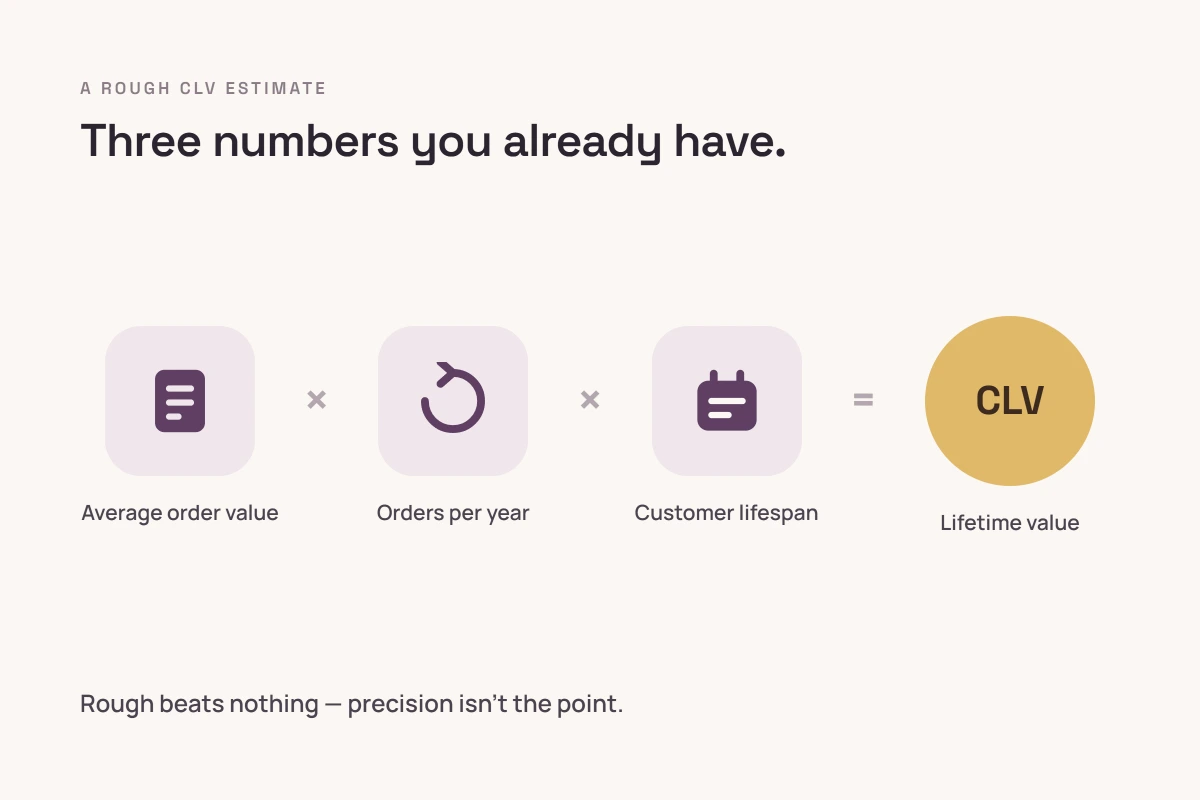
It won't be precise, and it doesn't need to be. The point isn't a perfect number. It's a rough sense of whether your acquisition spend is sustainable, and whether a small improvement in retention is worth more to your business than another push for new traffic.
A few practical levers that genuinely move CLV, none of which require guesswork:
- Reduce the rate of "wrong first purchase." A customer who buys the wrong product for their needs is far less likely to return. Helping people find the right thing the first time, whether through better navigation, clearer product pages, or a short guided quiz, protects the relationship before it even starts.
- Build a real post-purchase relationship. Email, loyalty programmes, and genuinely useful follow-up all compound over time.
- Fix your return experience. A smooth, fair return process keeps a bad first order from becoming a lost customer for good.
Full disclosure: the first point is directly relevant to what we build at Suggesto. A quiz that helps someone find the right product before they buy is a retention tool as much as a conversion one, since the surest way to lose a customer for good is selling them the wrong thing the first time. That said, the principle stands regardless of the method: reducing mismatched first purchases is one of the cheapest retention levers available.
Key takeaways
The "5% retention increase, 25 to 95% profit increase" statistic is real in origin but has been flattened into something more universal-sounding than the actual research supports. The honest version is that retention has a large, industry-dependent impact on profit, large enough to be worth genuine attention, not a single magic multiplier. Tracking even a rough version of CLV, and treating a mismatched first purchase as the retention risk it actually is, tends to matter more for a small store's long-term health than most people assume.
Frequently Asked Questions
What is customer lifetime value?
Customer lifetime value (CLV) is the total revenue a business can expect from a single customer across their entire relationship with that business, not just their first purchase.
Is the "5% retention increase = 25-95% profit increase" statistic accurate?
The underlying research is real, a 1990 Harvard Business Review study by Reichheld and Sasser, but the commonly repeated "25 to 95%" range is a popularised simplification. The original study found different, industry-specific figures (85% in banking, 50% in insurance, 30% in auto services), not one universal number, and it didn't study ecommerce at all.
How do I calculate customer lifetime value for my Shopify store?
A simple starting formula is average order value multiplied by average orders per customer per year, multiplied by average customer lifespan in years. It won't be exact, but it's useful for directional decisions about acquisition spend versus retention investment.
Why does customer lifetime value matter more than acquisition cost alone?
Acquisition cost only tells you what a customer cost to win. CLV tells you what they're actually worth. A high acquisition cost can still be profitable if customers return and spend repeatedly, while a low acquisition cost can be a poor deal if customers rarely come back.
References
- Reichheld, F. F., & Sasser, W. E. (1990). Zero Defections: Quality Comes to Services. Harvard Business Review.
- Bain & Company. Prescription for Cutting Costs.
- Gallo, A. (2014). The Value of Keeping the Right Customers. Harvard Business Review.