Dupe Culture: What It Means for Small Shopify Brands
Dupe culture is real, and 71% of Gen Z shop for cheaper alternatives. Here's what that actually means for a small, original Shopify brand.
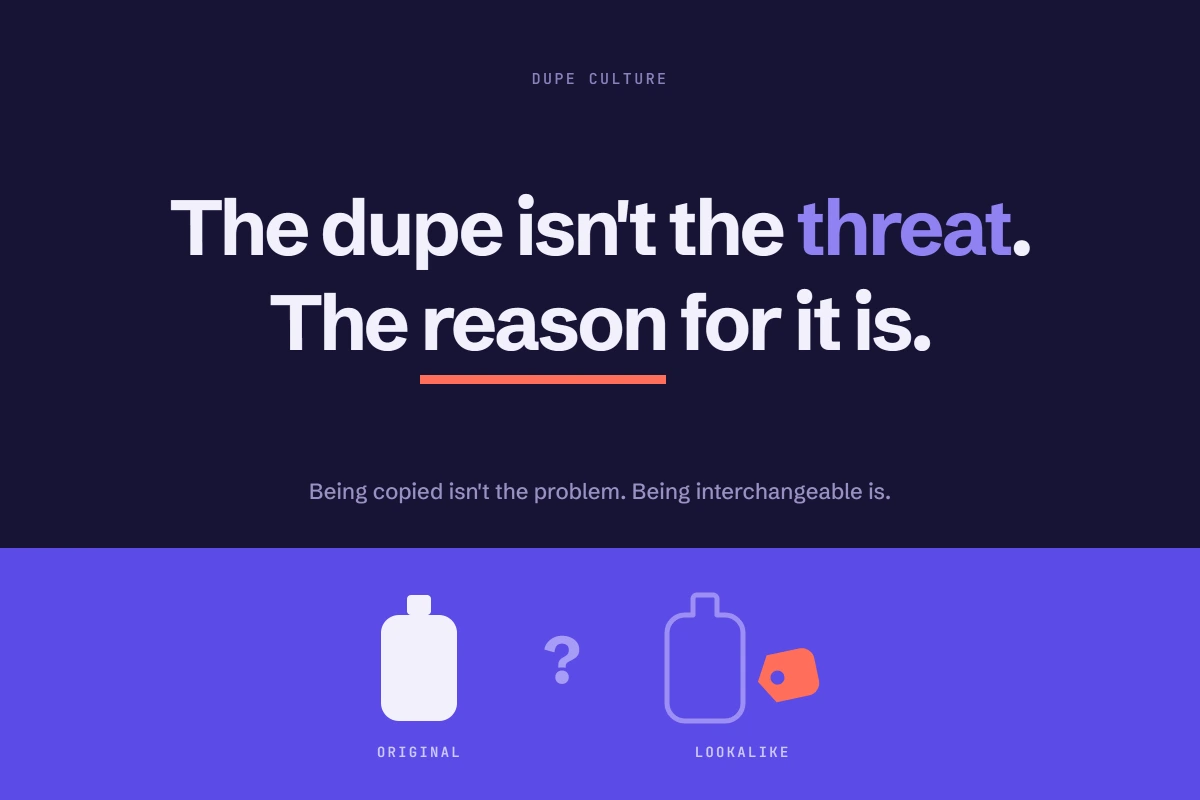
Somewhere on TikTok right now, someone is holding up a $12 lipstick next to a $45 one and asking their followers if they can spot the difference. Dupe culture has gone from a niche beauty-forum habit to one of the defining shopping behaviors of the decade, and it's easy to read as bad news if you're a small brand making something original. The more useful question is what it actually threatens, and what it doesn't.
What dupe culture actually is, and how big it really is
A dupe is a product designed to look, perform, or feel like a more expensive one, sold openly as an alternative rather than passed off as the real thing. That last part matters more than it sounds like it should, and we'll come back to it. Dupe culture is the broader shopping behavior built around finding, comparing, and buying these alternatives, usually via short-form video that puts the expensive original and the cheap stand-in side by side.
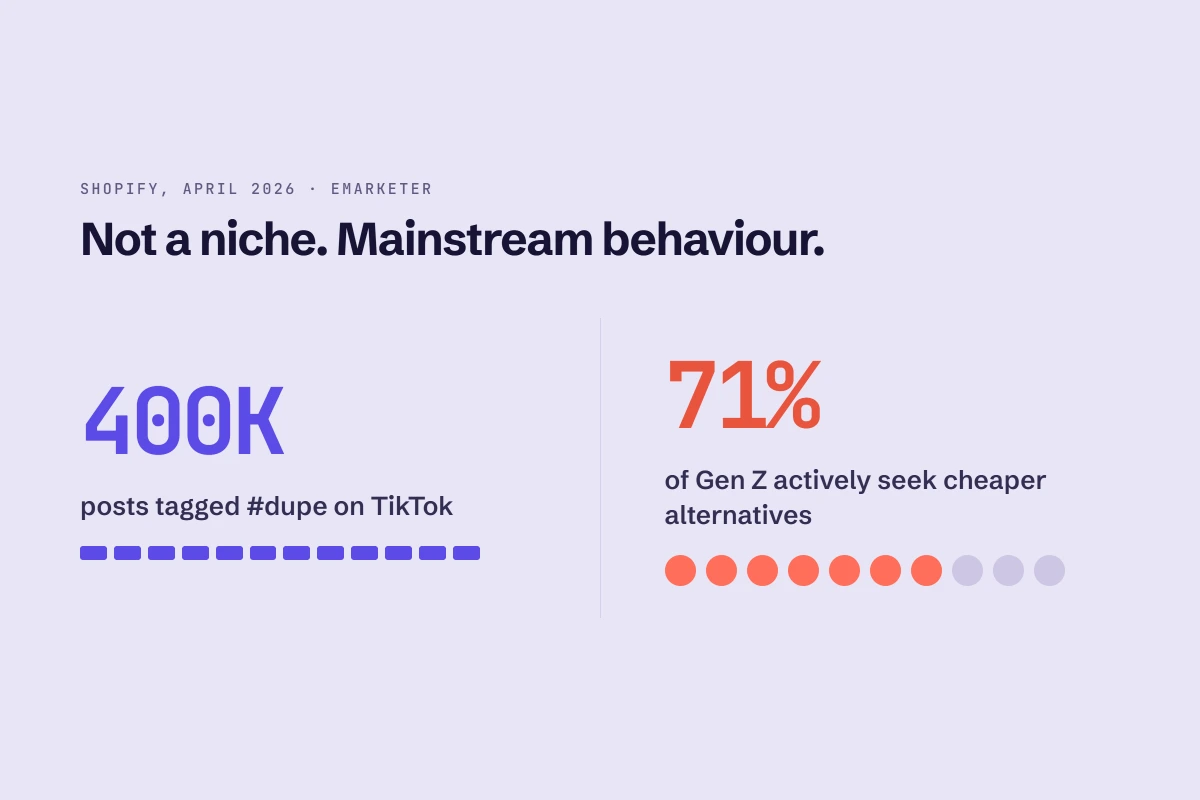
Shopify's own reporting on the trend, published in April 2026, found the #dupe hashtag has racked up roughly 400,000 posts and millions of views on TikTok. The same piece cites eMarketer data showing 71% of Gen Z shoppers now actively seek cheaper versions of name-brand products. Neither of those numbers is a fringe signal. This is mainstream shopping behavior for the generation that's about to make up a growing share of most stores' customer base.
Why it's happening now, in plain terms
Dupe culture isn't purely a frugality story, though cost matters. It's also a trust story. Shoppers, especially younger ones, have started asking pointed questions about what they're actually paying for: why a $200 sweater feels like polyester, why a $150 fragrance fades in two hours, whether a logo is doing work a formula or a fabric isn't. That skepticism lines up with a much larger, independently tracked shift. Deloitte's Global Consumer Products Industry Outlook found that 47% of consumers worldwide, including over a third of high-income households, now behave as "value seekers," people who deliberately trade convenience or brand loyalty for a better price-to-value ratio. Dupe hunting is one very visible expression of that mindset, not a standalone fad.
Is this actually a threat, or is it selective?
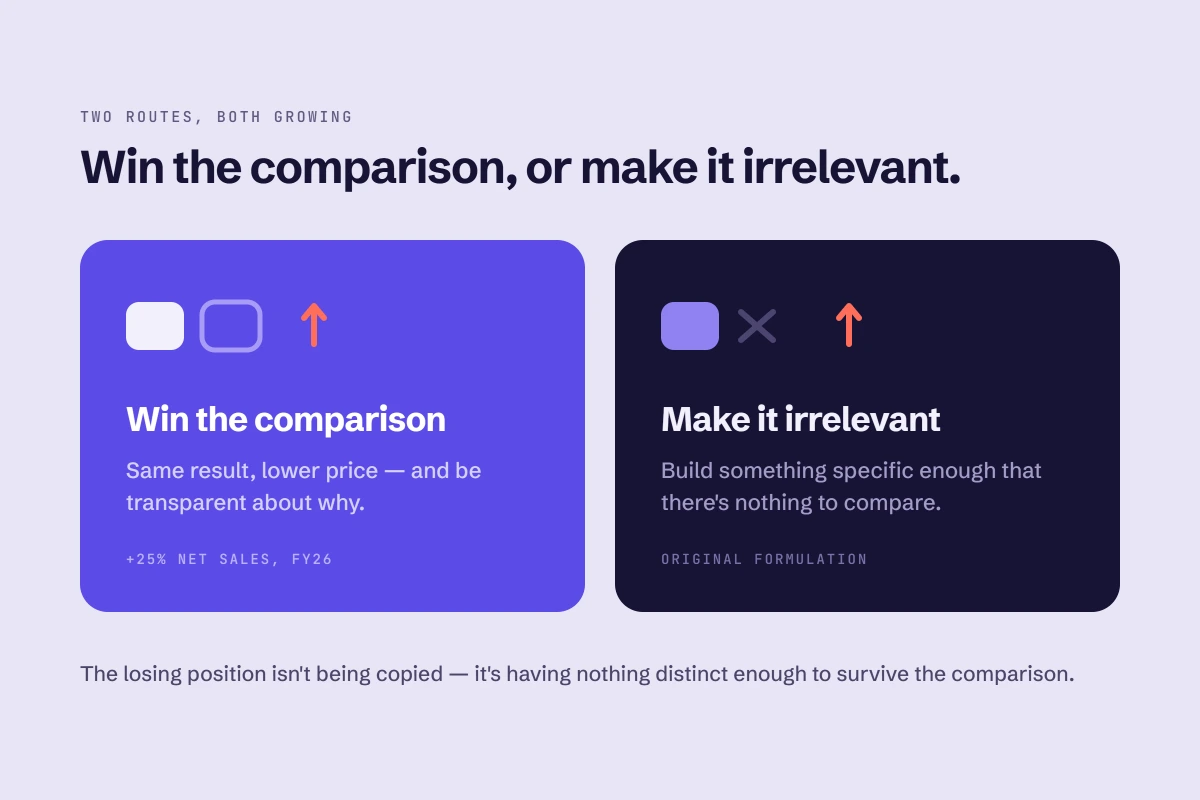
Here's where it gets more interesting than a simple "originals are dying" story. e.l.f. Beauty, a company that built much of its early identity on being the affordable, comparable alternative to prestige cosmetics, posted $1.64 billion in net sales for fiscal 2026, up 25% year over year, marking its seventh straight year of both net sales and market share growth according to the company's own results. That's not a brand losing to dupe culture. That's a brand whose entire positioning is built on it, and it's working at real scale.
At the same time, a set of brands built on the opposite instinct, refusing to play the comparison game at all, are also growing. Shopify's own interviews with three of them are worth knowing about specifically, because they show more than one path actually works:
- Italic partners with the same manufacturers that supply luxury houses, then designs original products rather than imitations of existing ones. Its COO, Avi Arora, told Shopify that dupe culture feeds fast fashion and expects it to fade as more shoppers buy with intention rather than to keep up appearances.
- Dossier started with fragrances explicitly "inspired by" luxury scents, then used that entry point to build trust before shifting focus to fully original formulations, which founder Sergio Tache says is now the company's real growth priority.
- Bubble Skincare builds dermatologist-developed formulas from scratch, prices most products under $20, and leans into the comparisons its own customers post rather than fighting them, on the logic that an unprompted customer comparison is a stronger trust signal than an ad could ever be.
None of these three brands is shrinking from dupe culture. They're routing around it, either by out-executing the price-comparison game (e.l.f.) or by making comparison beside the point through genuine originality (Italic, Dossier, Bubble). The losing position, based on what's actually happening in the market, isn't being compared to a dupe. It's having nothing distinct enough to survive the comparison.
The legal reality worth understanding, without treating this as legal advice
This is genuinely useful to know before a customer, a competitor, or your own instincts push you toward copying a bestseller's exact look, or reacting aggressively to someone copying yours.
Under US trademark law, a counterfeit uses a brand's actual name or logo to falsely claim to be the authentic product. That's straightforwardly illegal. A dupe is different: it typically avoids using the original brand's name or mark, and shoppers can generally tell it's an alternative rather than the real thing, which places dupes in a genuine legal gray area rather than automatic infringement. Courts have leaned into that distinction directly. In a trade dress dispute between Benefit Cosmetics and e.l.f. Cosmetics, e.l.f. successfully argued that the appeal of a dupe comes from the customer recognizing it as an imitation, not from being deceived into thinking it's the original, and the court found e.l.f.'s product hadn't actually confused consumers.
That doesn't mean anything goes. Brand owners are pushing back harder than they used to. Lululemon's 2025 lawsuit against Costco over lookalike leggings and jackets, dubbed the "Kirkland dupe" case in legal circles, alleges design patent, trademark, and trade dress infringement over specific product lines, and was still an active, closely watched case as of early 2026. Sol de Janeiro separately sued the brand MCoBeauty in late 2025 over packaging, color schemes, and marketing language it argues crossed from inspired-by into infringing. If your product design, packaging, or marketing language leans close to a specific competitor, that's a real legal exposure worth a genuine conversation with an actual attorney, not a guess based on a blog post, this one included.
What this means practically for a small Shopify brand
- Figure out honestly which side of dupe culture you're on. If your value proposition already is "as good, for less," lean into it the way e.l.f. has, with real transparency about formulation, materials, or sourcing so the comparison favors you.
- If you're the premium or original option, the fix isn't outrage, it's specificity. "We're the real one" doesn't compete with a $12 alternative. A specific, provable reason the product is different, a proprietary process, a sourcing story, a fit or performance detail a dupe genuinely can't replicate, does.
- Protect what's actually distinctive, early. Registered trademarks and, where it applies, trade dress protection are far stronger before a dupe exists than after one's already selling. This is a legal and design question worth raising with a professional before a launch, not after a viral comparison video.
- Help shoppers feel the difference instead of just claiming it. A big part of what makes a dupe purchase feel safe is that the shopper already knows exactly what they're getting and why it suits them, because a creator walked them through the comparison. A short guided quiz can do a version of that same job for your own original product: helping someone understand which specific option fits their skin, their build, their use case, so the purchase feels like an informed, personal match rather than a guess at a price point. That's a genuinely different kind of confidence than "trust me, it's worth more," and it's one a $12 lookalike can't easily offer.
Key takeaways
Dupe culture is a real, large-scale shift in how people shop, not a passing TikTok moment, and 71% of Gen Z now actively looks for cheaper alternatives to name brands. But the data doesn't show a simple story of small original brands losing out. e.l.f. Beauty is proof the comparison game can be won outright, and brands like Italic, Dossier, and Bubble Skincare are proof that building something genuinely original, and explaining why, works just as well. The legal line between a dupe and a counterfeit is real and increasingly contested in court, which makes early trademark and trade dress protection worth genuine attention. For most small brands, the practical answer isn't to fear the comparison. It's to make sure there's something specific enough at the center of it to win.
Frequently Asked Questions
What's the difference between a dupe and a counterfeit?
A counterfeit uses a brand's actual protected name or logo to falsely claim to be the authentic product, which is illegal under trademark law. A dupe typically avoids using the original brand's name or mark and is sold openly as a lower-cost alternative, which places it in a legal gray area rather than automatic infringement, though brand owners are increasingly challenging specific dupes in court over trade dress and design patents.
How big is dupe culture actually?
Shopify's own reporting found the #dupe hashtag has passed roughly 400,000 posts and millions of views on TikTok, and eMarketer data cited by Shopify shows 71% of Gen Z shoppers actively seek cheaper alternatives to name-brand products.
Is dupe culture actually hurting small original brands?
The evidence is mixed rather than one-directional. e.l.f. Beauty, built largely on affordable-alternative positioning, posted $1.64 billion in fiscal 2026 net sales, up 25% year over year. At the same time, brands like Italic, Dossier, and Bubble Skincare are growing by building original products and explaining why they're different, rather than competing on price comparison at all. Both approaches are working for different brands right now.
Can I get sued for making a product that looks like a bestseller?
Possibly, depending on specifics a general article can't evaluate for your product. Courts distinguish between lawful competition and infringement mainly by asking whether the similarity would actually confuse a consumer, and recent cases including Lululemon v. Costco and Sol de Janeiro v. MCoBeauty show brand owners actively testing that line in court. This is worth a real conversation with a trademark attorney before launch, not a guess based on general guidance.
References
- Shopify (In Stock). Anita Little. Trend Check: The Brands Beating Dupe Culture at Its Own Game (April 2, 2026).
- e.l.f. Beauty, Inc. e.l.f. Beauty Announces Fourth Quarter Fiscal 2026 Results, BusinessWire (May 20, 2026).
- Deloitte Global. 2026 Global Consumer Products Industry Outlook (January 2026).
- IPWatchdog. Run, Don't Walk: Dupe Culture, Trade Dress, and the Growing Fight Over Brand Identity (January 12, 2026).
- Wake Forest Journal of Business and Intellectual Property Law. Luxury for Less: Are Dupe Products Fair Competition or IP Infringement?
- Harvard Law School. Kirkland Dupes: A Conversation with Professor Fisher on Lululemon v. Costco (event listing, March 9, 2026).