Livestream Shopping: Does It Actually Convert?
US livestream sales hit $14.64 billion in 2025, but only 11% of viewers say they've ever bought from a creator livestream. Here's what actually converts.
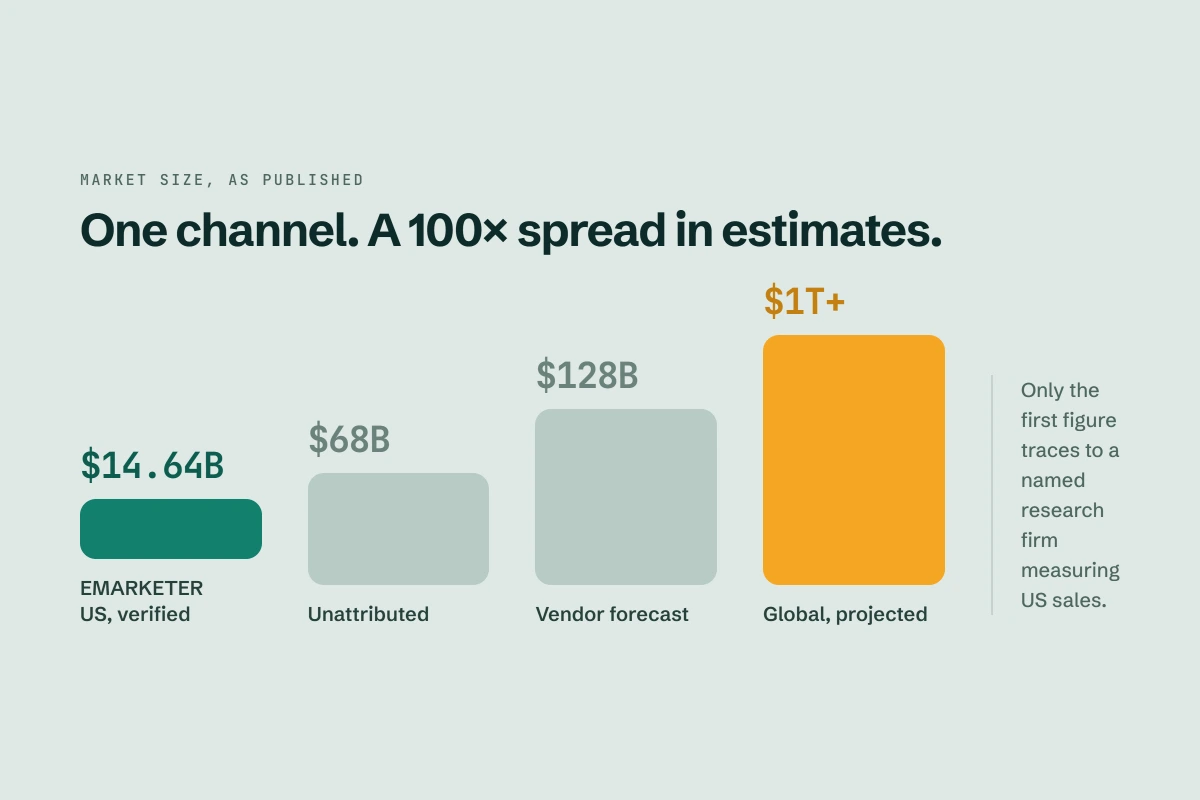
Search "livestream shopping statistics" and the market-size numbers you'll find range from $14 billion to over $1 trillion, sometimes on the same results page. That's a wider spread than almost any other stat this blog has tried to pin down, and it's worth sitting with for a second before believing anything else you read about this channel, including the numbers below.
What livestream commerce actually is, and the number that holds up
Livestream commerce is real-time video shopping: a host demonstrates products, answers questions as they come in, and viewers buy without leaving the stream. It's the format behind TikTok Shop's live tab, Whatnot's auction-style shows, Amazon Live, and QVC's own push into the space.
The most credibly sourced figure comes directly from EMARKETER, a genuine, named research firm, not a recycled blog estimate. US livestream ecommerce sales grew nearly 50% in 2025 to $14.64 billion, with the number of buyers up 21.5% year over year. That's a real, fast-growing number. It's also nowhere near the $68 billion, $128 billion, or "over $1 trillion" figures that circulate elsewhere, which tend to either blend in China's vastly larger market, project years into the future, or come from vendors selling livestream software. Treat this blog's own $14.64 billion figure as the most traceable one available, and treat any bigger number you see with real skepticism until you can see where it actually comes from.
The gap between watching and buying
Here's the part that matters more than the market-size headline. Plenty of people are exposed to livestream shopping. Far fewer actually buy through it. EMARKETER found that only 21.7% of US digital buyers made a purchase via livestream in 2025, and separately, 43% of US adults say they haven't used livestream shopping and aren't interested in it at all.
The sharpest version of this gap shows up in a joint EMARKETER and impact.com survey of creator-driven shopping: only 11% of people who follow creator content report ever having actually purchased from a creator's livestream. EMARKETER's own read on that number is direct: livestreams are most effective for brand building and community engagement, with a direct sale treated as a secondary benefit rather than the main event.
Worth knowing before you plan a budget around this: a widely repeated claim puts livestream conversion rates at 9% to 30%, against 2 to 3% for standard ecommerce pages. That figure traces back to Firework, a company that sells livestream shopping software, which is a real conflict of interest worth knowing about before treating it as an independent benchmark. It may well be directionally true for the specific brands running successful livestream programs. It's not a number every store should expect to hit by simply turning a camera on.
TikTok's own numbers say the format is shrinking as a share of sales, even while growing in dollars
This is the detail that got buried in most of the coverage. TikTok told CNBC in September 2026 that live shopping sales on the platform more than doubled in the first half of 2026 compared with the same period in 2025, with live sessions up more than 60% and total live hours up more than 80%. That sounds like unambiguous momentum.
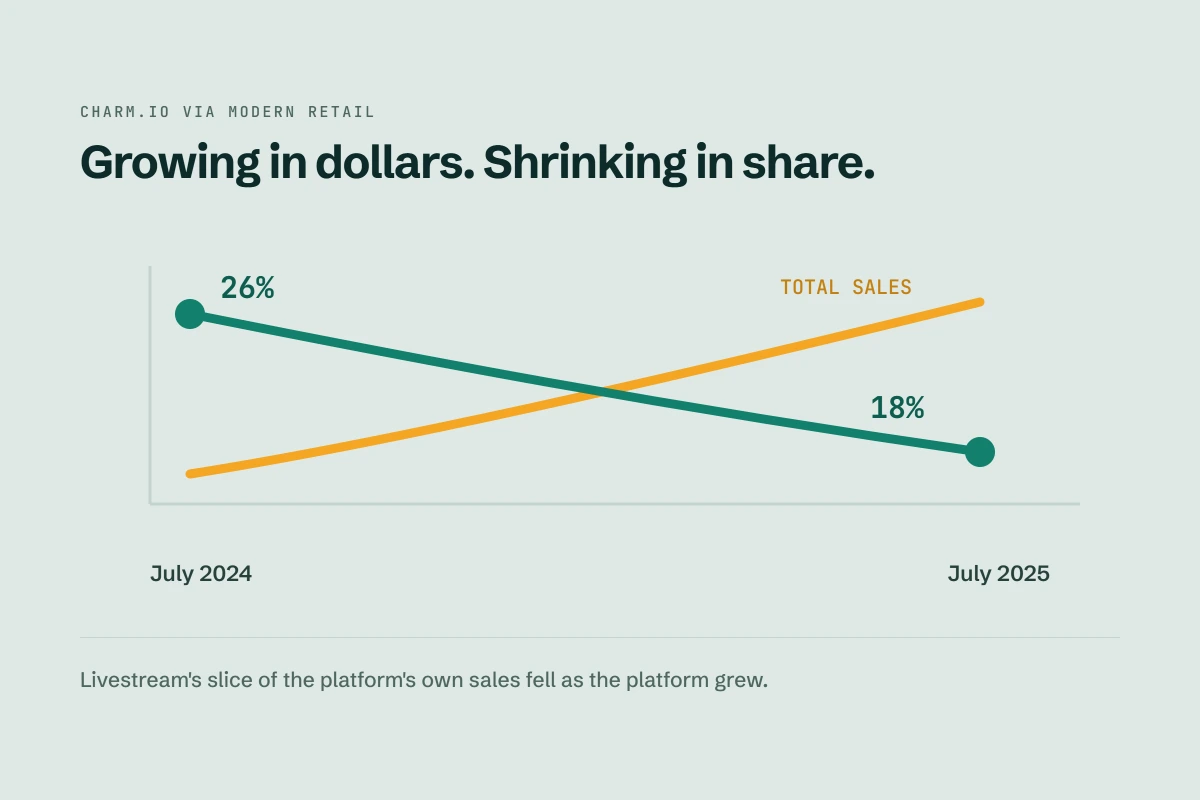
But TikTok Shop's own sales mix tells a more specific story. According to Charm.io data cited by Modern Retail and reported by EMARKETER, the share of total TikTok Shop sales coming from livestreams specifically fell from 26% in July 2024 to 18% in July 2025, even as TikTok Shop's overall sales kept growing. Livestream is generating more absolute dollars because the whole platform is bigger. It's becoming a smaller slice of that bigger pie, not the thing driving the growth.
Where it's actually working, and why that's narrower than it looks
None of this means livestream commerce is a dead end. It clearly works, for specific formats and specific categories. Whatnot, built entirely around live auction-style selling, expected to exceed $6 billion in sales in 2025 and reported that Black Friday shoppers that year bought at a pace of roughly 40 items per second, with first-time buyers up fourfold from the year before. Pop Mart, the collectible toy brand, generated 85% of its June 2025 TikTok Shop sales from livestreams specifically. The skincare brand goPure ran 483 hours of TikTok Live and generated $1 million in revenue and 64 million impressions from it.
What connects those examples is category fit and format fit, not livestream commerce working universally. Auctions, drops, collectibles, and limited releases create the kind of real-time scarcity and community energy a livestream is built for. A lot of ordinary product categories don't have that built-in drama, which is a large part of why the format hasn't caught on in the US the way it has elsewhere. Livestream commerce accounts for roughly 60% of China's ecommerce market, against approximately 5% in the US, according to ARK Invest. McKinsey's research on the US gap points to convenience as the single biggest barrier, cited by 32% of consumers who don't engage with the format, more than any concern about trust or price.
What this means practically for a small Shopify store
- Don't budget for livestream commerce as a direct-response channel first. EMARKETER's own guidance is to treat it as an awareness and community tool initially, and measure engagement, returning viewers, and community growth alongside sales rather than judging it purely on immediate conversion.
- Match the platform to your category, not the other way around. TikTok Shop favors algorithmic discovery among younger buyers, Whatnot favors collectors and enthusiast, drop-driven categories, and Amazon Live favors storytelling for people already shopping with intent. A format built for hype and scarcity will struggle in a category that's genuinely considered rather than impulsive.
- A charismatic host beats a polished production. This shows up consistently in how the channel actually performs. If you don't have someone who can hold a live audience for real, that's a bigger gap than your camera setup.
- If live hosting isn't realistic yet, you can still deliver the part of it that actually converts. What makes a livestream purchase feel safe isn't the video itself, it's a real person answering a shopper's specific question in the moment and pointing them to the right pick. A short guided quiz does an asynchronous version of that same job, all day, without needing a skilled host on camera for hours at a stretch. It's a reasonable lower-effort complement while you figure out whether live hosting is worth the production investment for your specific category, not a replacement for it if livestream genuinely fits what you sell.
Key takeaways
Livestream shopping is a real and growing channel in the US, worth roughly $14.64 billion in 2025 by the most traceable estimate available, not the wildly larger figures that circulate elsewhere. But growth in total dollars is hiding a narrower story: most shoppers aren't buying through it, TikTok's own platform mix shows livestream shrinking as a share of total sales even as the dollar figure rises, and the channel's clearest wins are concentrated in categories built for real-time drama, like collectibles, drops, and auctions. For most small Shopify stores, the honest starting point is treating livestream as a community and awareness tool first, matched carefully to a category that actually suits the format, rather than a guaranteed new sales channel.
Frequently Asked Questions
Does livestream shopping actually convert well?
Not broadly. EMARKETER found that only 21.7% of US digital buyers purchased via livestream in 2025, and a separate EMARKETER and impact.com survey found only 11% of people who follow creator content report ever having purchased from a creator's livestream. It performs much better in specific categories built for real-time scarcity, like collectibles and limited drops, than as a general-purpose sales channel.
How big is the livestream shopping market really?
The most traceable figure comes from EMARKETER: US livestream ecommerce sales reached $14.64 billion in 2025, up nearly 50% year over year. Larger figures circulating elsewhere, sometimes exceeding $1 trillion, typically blend in China's much larger market, project years into the future, or originate from companies selling livestream shopping software.
Why has livestream shopping succeeded in China but not the US?
According to ARK Invest, livestream commerce makes up roughly 60% of China's ecommerce market versus approximately 5% in the US. McKinsey research attributes much of the US gap to convenience, cited by 32% of US consumers as the main barrier, more than concerns about trust or pricing.
Is livestream's share of TikTok Shop sales growing or shrinking?
Shrinking, even as the dollar amount grows. According to Charm.io data reported by Modern Retail and cited by EMARKETER, the share of total TikTok Shop sales coming specifically from livestreams fell from 26% in July 2024 to 18% in July 2025, as TikTok Shop's overall sales continued to increase.
References
- EMARKETER. FAQ on Livestream Commerce: What Marketers Need to Know About Live Shopping in 2026 (January 16, 2026).
- CNBC. Livestream Shopping Is Gaining Steam in the U.S., Thanks to Apps Like TikTok and Whatnot (September 1, 2026).
- ARK Invest. Livestream Commerce: Reviving Home Shopping.
- McKinsey & Company. Ready for Prime Time? The State of Live Commerce.