Loyalty Programs: Do Points Actually Bring Customers Back?
Decades of independent marketing research suggests loyalty programs mostly reward customers who were buying from you anyway. Here's the real evidence.
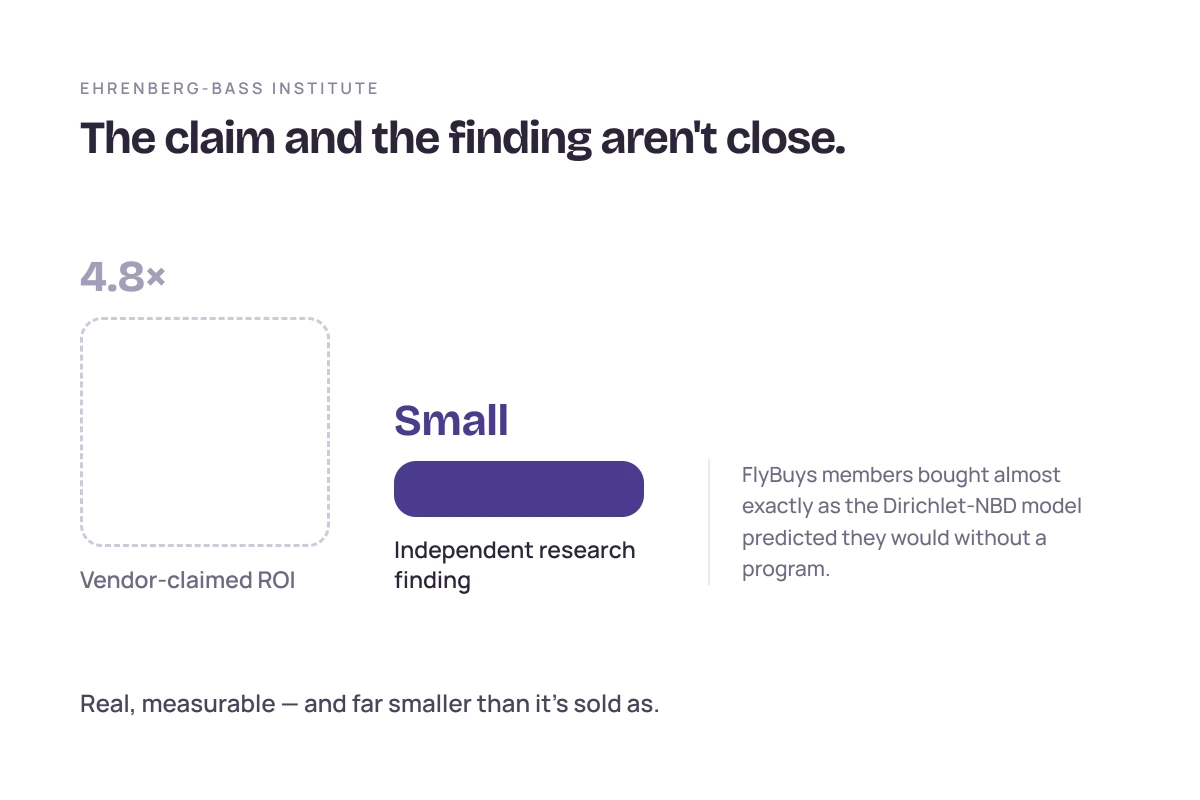
Search for data on loyalty program effectiveness and you'll find a lot of vendor blogs quoting each other: 20 to 30% repeat purchase boosts, 15 to 20% conversion uplifts, a suspiciously precise "4.8x average ROI." None of it traces back to a real, checkable study. What does trace back to real research tells a much more interesting, and considerably less flattering, story.
The academic case against loyalty programs
Byron Sharp directs the Ehrenberg-Bass Institute for Marketing Science at the University of South Australia, a genuine academic research institute, not a company selling loyalty software. His team has spent decades testing marketing's popular assumptions against real purchase data, and loyalty programs have taken a repeated beating.
The first empirical study on this, published by Sharp and a co-author back in 1997, found only a small amount of "excess loyalty" attributable to having a program at all, a weak effect, later replicated by others at a similarly modest size. More recent work has gone further. A well-known analysis examined FlyBuys Australia, one of the largest multi-brand loyalty programs in the world, and compared how participating brands' customers actually behaved against the Dirichlet-NBD model, the standard statistical model marketing scientists use to predict purchase patterns in competitive categories with no loyalty program involved at all.
The result: no significant deviation. Loyalty program members bought largely the way the model predicted they would have bought anyway.
This connects to something called the Double Jeopardy Law, a pattern Andrew Ehrenberg documented and which has since been replicated across hundreds of product categories over several decades. It states that smaller-market-share brands inherently have both fewer customers and slightly less frequent buyers among them, a double penalty. A loyalty program doesn't change this pattern. A brand with 5% market share shows the loyalty profile the maths predicts for a 5%-share brand, points programme or not.
A separate flaw in the stat everyone quotes
There's a well-known claim floating around retail and marketing content: cut customer churn by 5%, and profit rises by a huge amount, sometimes stated as high as 95%. Sharp went looking for the evidence behind it and found something worth knowing on its own: the claim confuses two very different things. Reducing churn from 10% to 5% sounds like "a 5% reduction," but it's actually a 50% reduction, cutting the original number in half, not trimming it by five percentage points. That's a tenfold difference in what's actually being measured, which goes a long way toward explaining why the resulting profit figure looks so dramatic.
This is a different flaw from the one commonly raised about the same statistic elsewhere (the original 1990 study measured different, industry-specific results rather than one universal number). Both issues are real, and together they explain a lot about why a genuinely useful piece of 1990s research turned into a soundbite that doesn't hold up well under scrutiny.
So do loyalty programs do nothing?
Not quite, and it's worth being precise here rather than swinging to the opposite extreme. Sharp's own research finds a small, real, measurable effect, just a much smaller one than the industry markets it as. His actual practical argument isn't "never run a loyalty program." It's that the bigger, more reliable growth lever sits somewhere else entirely: reaching new and light buyers, the people who don't already shop with you, rather than working harder to reward the people who already do.
That reframe is genuinely useful for a small Shopify store. The customers a loyalty program rewards are, by definition, the ones already coming back. The customers a store actually needs more of are the unfamiliar, first-time, uncertain ones who haven't decided whether to buy from you at all yet. That's a completely different problem, and it calls for a different kind of investment: making the first purchase experience for a stranger as easy and confident as possible, rather than adding more incentive layers for people already convinced.
That's also, honestly, closer to the actual problem we spend time on at Suggesto: helping a new, unfamiliar visitor find the right product and buy with confidence the first time, since that's the growth lever the research suggests actually moves the needle, rather than a points balance for people who were shopping with you regardless.
Key takeaways
The loyalty-program industry is built on a statistic that doesn't hold up well under scrutiny and a research base that's thinner than the marketing suggests. Decades of independent marketing science point to a modest real effect that mostly rewards customers who were buying anyway. That doesn't mean scrap your loyalty programme. It means don't expect it to be your main growth engine, and don't neglect the much larger opportunity sitting with the new and uncertain customers a points balance was never designed to reach.
Frequently Asked Questions
Do loyalty programs actually increase customer retention?
Research from the Ehrenberg-Bass Institute for Marketing Science found that loyalty program members' purchase patterns closely matched what a standard statistical model predicted they would have been anyway, suggesting a much smaller real effect than commonly claimed.
Is the "5% retention increase boosts profit by up to 95%" statistic accurate?
Marketing scientist Byron Sharp identified a specific mathematical error in how this claim is commonly interpreted: a drop from 10% to 5% churn is actually a 50% reduction, not a 5% one, a tenfold difference that helps explain why the resulting profit figures look so dramatic.
What actually drives growth better than a loyalty program?
According to Byron Sharp's research, reaching new and light buyers, people who don't already shop with a brand, tends to offer more available growth than deepening the loyalty of customers who are already buying regularly.
Should a small Shopify store still run a loyalty program?
The research suggests a loyalty program has a real but modest effect, mostly rewarding existing customers rather than creating new ones. It's reasonable to run one, but it shouldn't be treated as a primary growth strategy, and effort spent making a strong first impression on new customers is likely to matter more.
References
- Sharp, B., & Sharp, A. (1997) and subsequent Ehrenberg-Bass Institute research on loyalty programs.
- Sharp, B. (2010). How Brands Grow: What Marketers Don't Know. Oxford University Press.
- Sharp, B., & Romaniuk, J. (2022). How Brands Grow, Part 2. Oxford University Press.