Social Commerce and TikTok Shop: Is It Worth the Effort for Small Shopify Stores?
TikTok Shop's 2026 sales numbers range from $15 billion to $27 billion depending which article you read. Here's what's actually verifiable.
Search "TikTok Shop statistics 2026" and you'll find dozens of articles, each stating precise-sounding numbers that don't agree with each other. One says TikTok Shop's US sales will hit $15.1 billion this year. Another says $23.4 billion. Another says $27 billion. All three claim to be citing the same research firm.
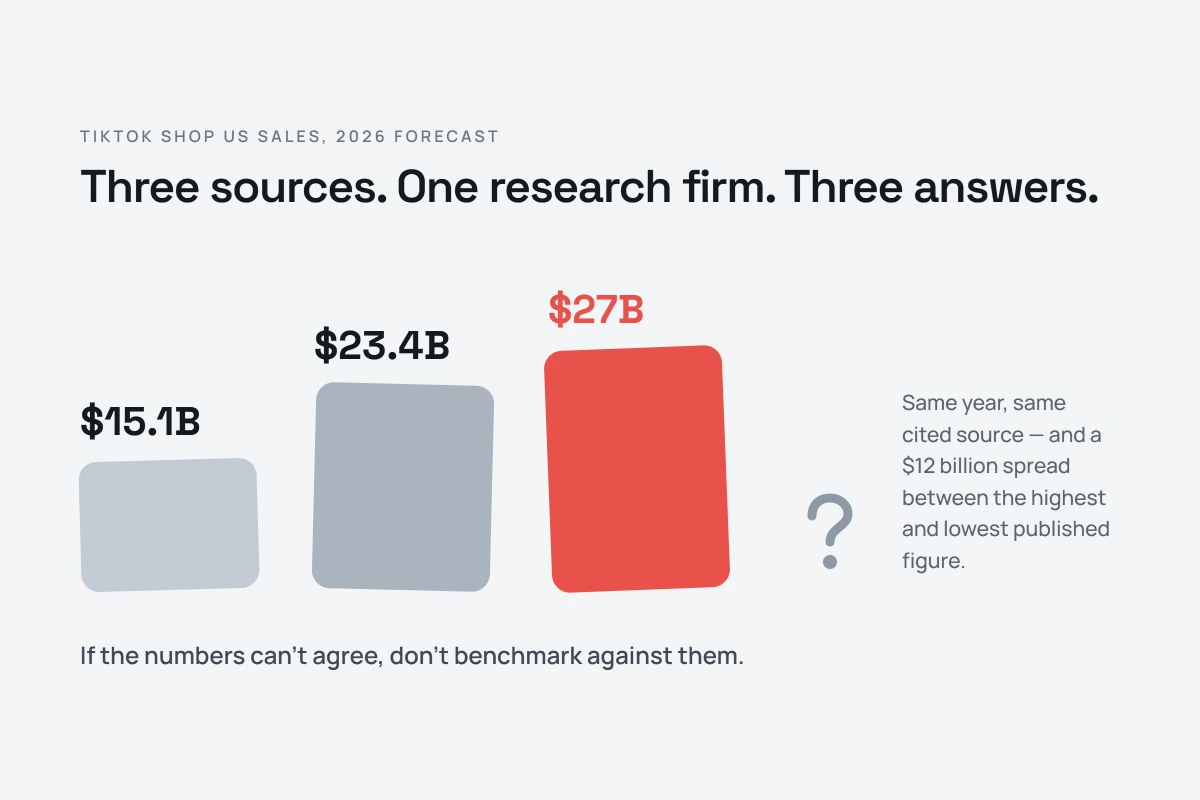
That inconsistency is worth pausing on before believing any single number, including the ones in this article.
Why this topic is genuinely hard to research honestly
Nearly every "TikTok Shop stats" article circulating right now recycles figures from other articles rather than tracing them to an actual named report. Fee structures suffer the same problem: different "complete guide" sites cite a 1.8% transaction fee, an 8% referral fee, and a 5 to 6% commission, sometimes on the same page as each other. One widely repeated claim, that 82% of TikTok Shop sellers lose money, appears on exactly one low-quality source with no discoverable methodology behind it. Treat it as unverified, because it is.
This isn't unique to TikTok Shop, but the sheer volume of confident-sounding, contradictory content here is unusual even by ecommerce-blog standards. So instead of adding one more disputed number to the pile, here's what's actually traceable.
What's reasonably well supported
The most consistent, credibly sourced figure comes via Retail Dive, a genuine trade publication, citing eMarketer directly: US social commerce sales are forecast to cross $100 billion for the first time in 2026, with TikTok Shop accounting for roughly 18 to 20% of total US social commerce in 2025. Half of US social shoppers are projected to make a purchase on TikTok Shop by the end of 2026. These figures show up consistently enough, attributed to a real named research firm through real journalism, to treat as directionally reliable, even if the exact decimal points vary by a percentage point or two between citations.
Beyond the headline numbers, the actual seller experience is more useful to understand than any growth chart. Across the maze of inconsistent fee guides, one theme holds steady regardless of which exact percentage a given site quotes: TikTok Shop's own platform commission tends to be the smaller cost. The bigger, less visible expense is affiliate and creator commissions, commonly cited in the 25 to 30% range and sometimes higher, because the platform is built around discovery through content and creators rather than search, and getting seen without paying for that discovery is genuinely difficult.
What that actually means for a small store
TikTok Shop isn't a simple "list your products and wait" channel the way a marketplace listing can be. It behaves more like a content and creator relationship business that happens to process payments, and the real cost of participating shows up in content production and creator commissions more than in a line-item platform fee.
That has a few practical implications worth weighing before jumping in:
- Budget for content and creators, not just a platform fee. If you're comparing TikTok Shop's headline commission against Shopify's own checkout, you're comparing the wrong numbers. The affiliate layer is where most of the real cost sits.
- Products that work well on video tend to do better. Visually demonstrable, impulse-friendly items in a modest price range are consistently mentioned across sources as the category that performs, more so than considered, higher-ticket purchases.
- It's a genuinely different skill set, not a Shopify add-on. Succeeding here leans on content and creator relationships more than on the merchandising and CRO skills that make a Shopify store convert well.
- The inconsistent public data is itself a signal. A channel this hard to get clean information about is also a channel where it's hard to benchmark your own performance against anyone else's. Go in expecting to run your own experiment rather than expecting to hit numbers from an article.
Key takeaways
The honest version of "is TikTok Shop worth it" isn't a number, it's a warning about the numbers themselves. Most of what's published about TikTok Shop's performance can't be traced to a real, checkable source, and the figures that can be verified point to a real, fast-growing channel where the actual cost of participating is mostly hidden in creator commissions rather than the platform's own fees. Treat any single "X% ROI" claim about this channel with real scepticism, including ones on well-designed blogs that sound authoritative.
Frequently Asked Questions
Is TikTok Shop actually growing?
Yes, based on the more credibly sourced figures available. US social commerce overall is forecast to exceed $100 billion in 2026 for the first time, with TikTok Shop representing roughly a fifth of that total in 2025, according to eMarketer data reported by Retail Dive.
What does TikTok Shop actually cost sellers?
The exact platform fee percentage varies significantly across sources that couldn't be independently reconciled. What's more consistently useful to know is that affiliate and creator commissions, often 25 to 30% or more, tend to represent a bigger real cost than the platform's own transaction fee.
Should a small Shopify store bother with TikTok Shop?
It depends heavily on whether your products are visually demonstrable and whether you have capacity for content and creator relationships, since that's where the real investment lies, not in the platform fee itself. It behaves more like a content channel than a simple sales channel.
Why do TikTok Shop statistics vary so much between articles?
Much of the publicly available content on this topic recycles figures from other secondary sources rather than tracing them to an original report, so numbers drift and inflate as they're repeated. Figures attributed to credible, named research firms and reported through genuine journalism are more trustworthy than numbers appearing only on marketing blogs.
References
- Retail Dive, citing eMarketer. TikTok Shop Drives Social Commerce Growth.