What Is AEO (Answer Engine Optimization), and Why Should Shopify Merchants Care?
AI summaries are cutting search clicks roughly in half. Here's what Answer Engine Optimization actually is, and what the real data says about it.
For twenty years, ranking on Google meant one thing: get your link into a list of blue text and hope someone clicks it. That's changing, and the data on how much it's changing is more concrete than most of the acronyms flying around would suggest.
What AEO actually is
Answer Engine Optimization, AEO, is the practice of structuring your content so that AI systems, Google's AI Overviews, ChatGPT, Perplexity, Gemini, can understand it, trust it, and use it directly in the answer they generate for someone, whether or not that person ever clicks through to your site.
Traditional SEO optimizes for a ranking position. AEO optimizes for something slightly different: being the source an AI system pulls from and, ideally, names, when it answers a question a searcher never fully typed out as a query in the old sense. The two overlap heavily, being well-structured and trustworthy helps with both, but the goal has shifted from "win the click" to "win the citation."
The data behind why this matters
The most credible research on this comes from the Pew Research Center, a genuinely independent, nonpartisan organisation with no product to sell. In July 2025, Pew published an analysis that tracked the real browsing behaviour, not estimates or survey guesses, of 900 U.S. adults across 68,879 actual Google searches in March 2025.
The findings were stark. About 58% of people had at least one search that month produce an AI-generated summary. When a summary appeared, users clicked through to a traditional search result only 8% of the time. When no summary appeared, that number was 15%, roughly double. Clicking a link inside the AI summary itself happened just 1% of the time.
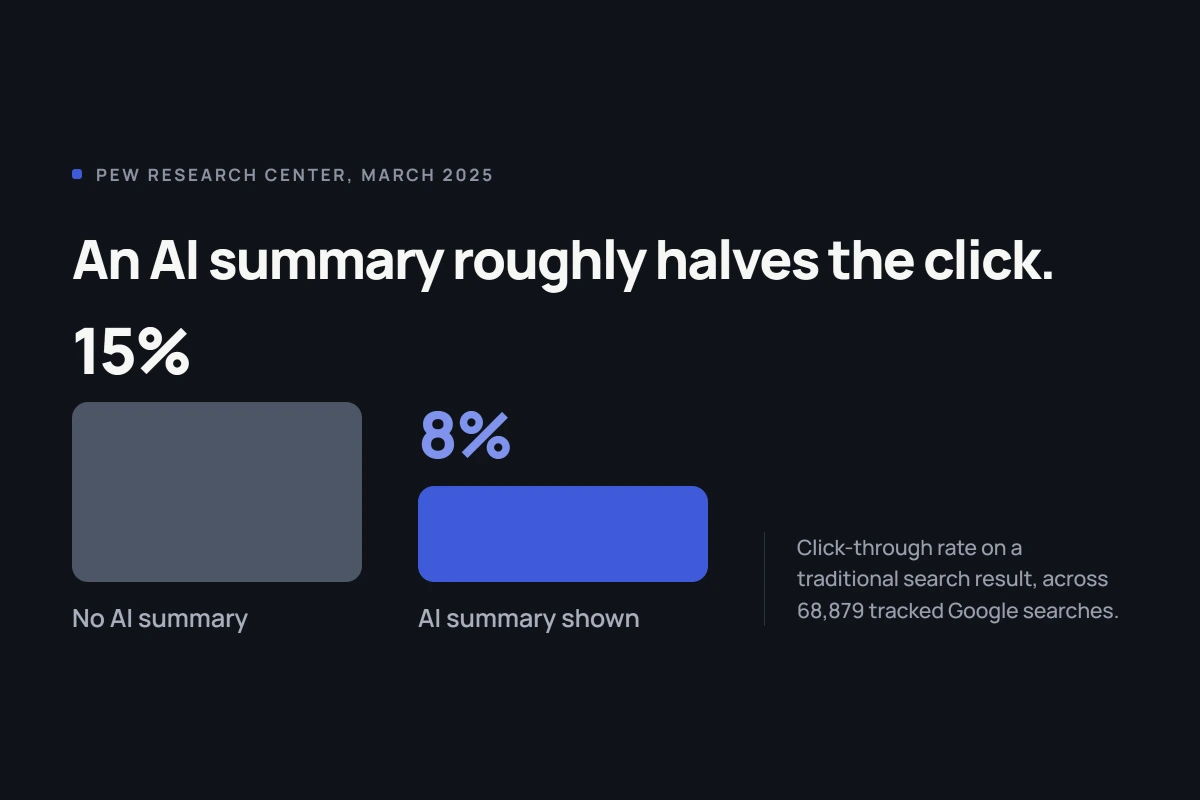
Worth knowing: Google publicly disputed Pew's methodology, saying the study's window overlapped with unrelated algorithm testing. Pew has stood by its numbers. It's also a single-month, US-only, Google-only snapshot, not a universal law that applies to every market or every query type forever. Treat the direction of the finding, clicks fall meaningfully when an AI summary appears, as well established, and treat the exact 8%/15% figures as a snapshot in time rather than a permanent constant.
Why this is a genuine shift, not just another acronym
It's tempting to file AEO alongside the parade of marketing acronyms that show up every year and mostly don't matter. The Pew data suggests this one is different, because it's measuring an actual behaviour change, not a prediction. Pew also found that 88% of AI summaries in their study cited three or more sources, and only 1% cited a single source, which means AI systems are already pulling from multiple pages to build an answer. Being one of those cited pages is the new version of ranking on page one.
For a Shopify merchant, the practical implication isn't "abandon SEO." It's that a growing share of informational searches, the "how do I choose a coffee grinder" or "what's the difference between X and Y" type queries that used to send a browsing visitor to a blog post, now get answered without a click at all. Content written to be the clearest, most extractable answer to a specific question has a better shot at being the source an AI system cites, even if the click-through rate on that particular search has fallen.
What actually helps
A few things are consistent across credible AEO guidance right now, and none of them require abandoning good writing practice:
- Answer the question directly and early. AI systems tend to pull short, clearly stated passages, not buried conclusions three paragraphs in.
- Structure content clearly. Headers, short paragraphs, and a logical flow make a page easier for both a person and an AI system to extract from.
- Still rank organically. Being index-eligible and already visible for a query or closely related ones remains a prerequisite for most AI systems to consider citing a page at all. AEO sits on top of solid SEO, it doesn't replace it.
Key takeaways
The headline number, roughly half the click-through rate when an AI summary appears, comes from real, independently tracked browsing data, not vendor marketing. Whether or not you chase the AEO label specifically, the underlying shift is real: a meaningful share of search traffic is being answered before anyone reaches your site. Writing clear, directly-answering, well-structured content is the best response to that shift, and it happens to be good practice regardless of which acronym is trending this year.
Frequently Asked Questions
What does AEO stand for?
Answer Engine Optimization. It's the practice of structuring content so AI systems like Google's AI Overviews, ChatGPT, and Perplexity can understand, trust, and cite it directly in the answers they generate.
Is AEO different from SEO?
They overlap significantly. Traditional SEO optimizes for ranking position and clicks. AEO optimizes for being the source an AI system cites in a generated answer, which may or may not lead to a click. Most credible guidance treats AEO as sitting on top of good SEO, not replacing it.
Do AI summaries really reduce website traffic?
According to Pew Research Center's tracked browsing data from March 2025, click-through rates on traditional search results roughly halved (from 15% to 8%) when an AI summary appeared on the results page.
Should a small Shopify store worry about AEO?
It's worth understanding the shift, but not worth chasing at the expense of writing genuinely useful content. Clear, well-structured, directly-answering content tends to perform well for both traditional search and AI citation.
References
- Pew Research Center. Do people click on links in Google AI summaries? (July 22, 2025).